

Imagine waking up tomorrow without your smartphone, without the ability to board a plane to another country, without the internet to browse social media, and without GPS to navigate an unfamiliar road.
Sounds almost unbearable, right? Yet just a hundred years ago, none of these technologies existed. Today, we live in an era where technology is inseparable from everyday life — and many of the tools we rely on were born from the minds of visionary American inventors.
The United States has a long history as a nation of innovators. American inventors have created technologies that didn’t just transform life at home — they reshaped the entire world. Some of these inventions were so revolutionary that it’s nearly impossible to picture modern life without them.
Read also: 7 American Historical Figures Who Inspired the World
1. The Telephone — Alexander Graham Bell (1876)
On March 10, 1876, a simple sentence spoken by Alexander Graham Bell to his assistant Thomas Watson changed the history of human communication forever: “Mr. Watson, come here, I want to see you.” It was the world’s first telephone call, and nothing would ever be the same again.
Bell was a Scottish-born teacher for deaf children who had immigrated to America. He was deeply fascinated by the science of sound and communication. Together with Watson, he spent years experimenting with ways to transmit the human voice through electrical wire. Many thought it was impossible — but Bell refused to give up.
The breakthrough came when Bell discovered how to convert sound waves into electrical signals that could travel through a wire and be converted back into sound at the other end. In that historic moment in March 1876, when Bell accidentally spilled acid and called out to Watson for help, his voice came through clearly on their invention. The telephone was officially born.
Within a few decades, telephone networks spread across America and then around the world. From large, heavy home phones, the technology evolved into mobile phones, and eventually into the smartphones we hold in our hands today.
2. The Airplane — The Wright Brothers (1903)
Throughout history, humans have always dreamed of flying like birds — from the myth of Icarus in ancient Greece to Leonardo da Vinci’s sketches of flying machines. But it took two brothers from Dayton, Ohio, Orville and Wilbur Wright, to turn that dream into reality.
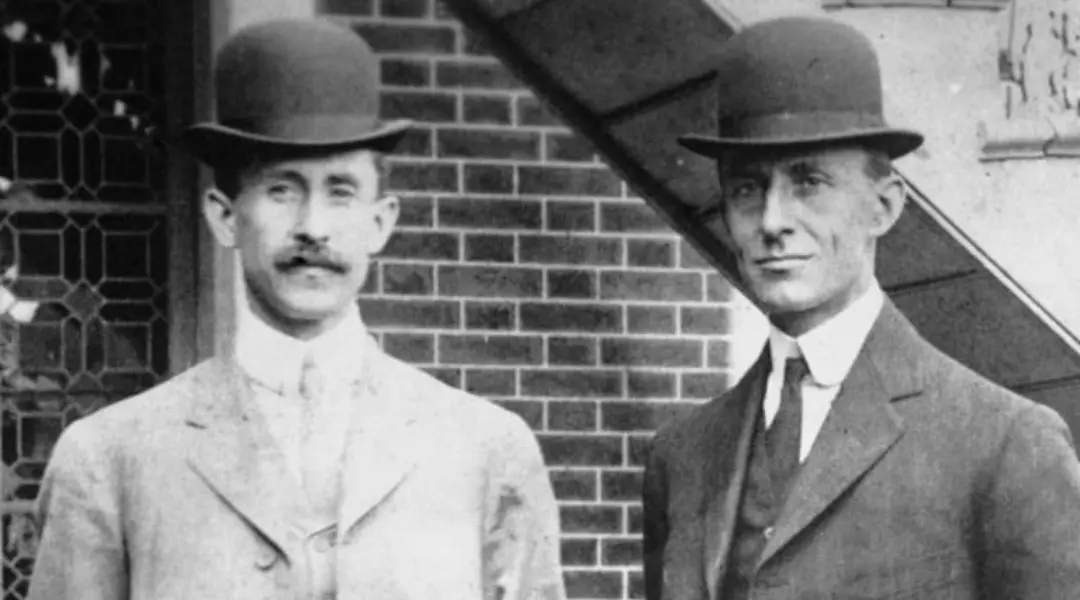
The Wright Brothers weren’t scientists or engineers with advanced degrees. They were bicycle shop owners with a deep passion for mechanics and flight. What set them apart from the hundreds of other inventors trying to build a flying machine was their systematic, scientific approach. Instead of guessing, they researched, built prototypes, and carefully tested every theory.
They spent years studying aerodynamics, testing different wing shapes in a wind tunnel they built themselves, and designing a control system that allowed a pilot to maneuver the aircraft in three dimensions. They even designed their own engine, because no existing engine was light enough yet powerful enough for their aircraft.
December 17, 1903: The Day Man First Flew
On a cold and windy morning at Kitty Hawk, North Carolina, history was made. Orville Wright climbed into their plane, the Wright Flyer, while Wilbur ran alongside to help. The engine roared, the plane moved along the rail, and for the first time in human history, a motor-powered aircraft heavier than air successfully flew with a pilot on board.
That first flight lasted only 12 seconds and covered just 37 meters, shorter than the length of a modern Boeing 747. But it was enough. The brothers made four flights that day, with the longest lasting 59 seconds and covering 260 meters. A centuries-old dream had finally come true: humans could fly.
The impact of the Wright Brothers’ invention on the world was staggering. Within decades, aircraft evolved from simple experiments into commercial aviation, turning intercontinental journeys that once took weeks by ship into trips of just a few hours.
The world became smaller and more connected — all because of 12 seconds in the sky above Kitty Hawk.
Read also: The Birthplace of World Innovation, Silicon Valley

3. The Internet — ARPANET (1960s)
If you’re reading this article online right now, you’re using one of the most transformative inventions in human history: the Internet.
The story of the Internet began in the late 1950s, when the United States established ARPA (Advanced Research Projects Agency). One pressing concern at the time: what would happen if a military communication system was disrupted? Scientists began thinking about building a decentralized communication network, one with no single point of failure. If one part went down, the rest would keep working. That brilliant idea eventually gave birth to ARPANET.
Read also: The History of NASA: Innovations in Space Technology
October 29, 1969: The First Message on the Internet
On that historic evening, a student named Charley Kline at UCLA tried to send the message “LOGIN” to a computer at Stanford Research Institute, about 560 kilometers away. He successfully typed “L” and “O”, then the system crashed. The very first message ever sent over the Internet was simply: “LO.”
An hour later, after the system was restarted, the full word “LOGIN” was successfully transmitted. The Internet had been born: two computers hundreds of kilometers apart could now communicate directly.
ARPANET grew, connecting more universities and research institutions. Email was invented in 1971, making digital communication even easier. But what truly ignited the Internet explosion was when Tim Berners-Lee created the World Wide Web in 1989, a system that allowed people to create and access web pages through a browser. Suddenly, the Internet wasn’t just for scientists and engineers. Anyone could use it.
By the 1990s, the Internet had entered homes. Email replaced letters. Websites became the primary source of information. E-commerce was born. Then came the 2000s, when social media transformed the way we connect with each other.
Video streaming, cloud computing, and always-connected smartphones all exist because of the Internet.
4. GPS — Global Positioning System (1978)
Have you ever used Google Maps to find an address? That app runs on GPS (Global Positioning System) technology, once a closely guarded American military secret, now an indispensable part of everyday life around the world.
The first GPS satellite was launched in 1978, and the full system of 24 satellites was completed in 1993. The concept: these satellites orbit the Earth and continuously broadcast radio signals containing information about time and position. A GPS receiver on the ground picks up signals from at least four satellites and, using complex mathematics, calculates the receiver’s position with accuracy down to just a few meters.
In the beginning, GPS was an expensive, classified military technology. Only the U.S. military had full access to its high-precision capabilities. But in 1983, following the tragic crash of Korean Air Lines Flight 007, President Reagan decided to open GPS for free civilian use.
The impact of GPS on modern life has been profound. Today, its applications span nearly every field. Farmers use GPS for precision agriculture, planting and harvesting with maximum efficiency. Scientists use it to study the movement of tectonic plates and predict earthquakes. Biologists track the migration of wildlife. Delivery companies optimize routes in real time. Every day, people navigate new cities without ever getting lost.
And the most remarkable part? GPS is completely free for anyone, anywhere in the world. The United States spends billions of dollars to maintain and upgrade the GPS satellite system, but charges users nothing. It is one of the most valuable public goods ever created.
The Spirit of Innovation Lives On
From the telephone to the airplane, from the Internet to GPS, American inventions have fundamentally reshaped how we live, work, travel, and connect. These weren’t just technological achievements, they were leaps of human imagination, born from curiosity, persistence, and the courage to pursue ideas that others thought were impossible.
And the best part? The spirit of innovation is something anyone can embrace. Whether you’re a student, a professional, or simply someone who wonders how the world works, learning about the history of human invention can spark ideas and inspiration for what you might create next.
Want to explore American innovation and culture more deeply? Check out @america at Pacific Place Jakarta for workshops, talks, and events that dive into the history of science, technology, and creativity.
Follow @america on Instagram to stay updated on upcoming programs, and come discover how brilliant ideas change the world.