
Have you ever heard the song “Get Your Kicks on Route 66”? Or perhaps watched the animated film Cars, which tells the story of a small town along a forgotten highway?
Both reference Route 66 — a legendary road that has become a symbol of freedom, adventure, and the American dream for nearly a century.
Stretching across eight states with scenery that shifts from city skylines and barren deserts to cornfields and mountain ranges, Route 66 is no ordinary highway. In this article, let’s trace the story of Route 66.
What Is Route 66?
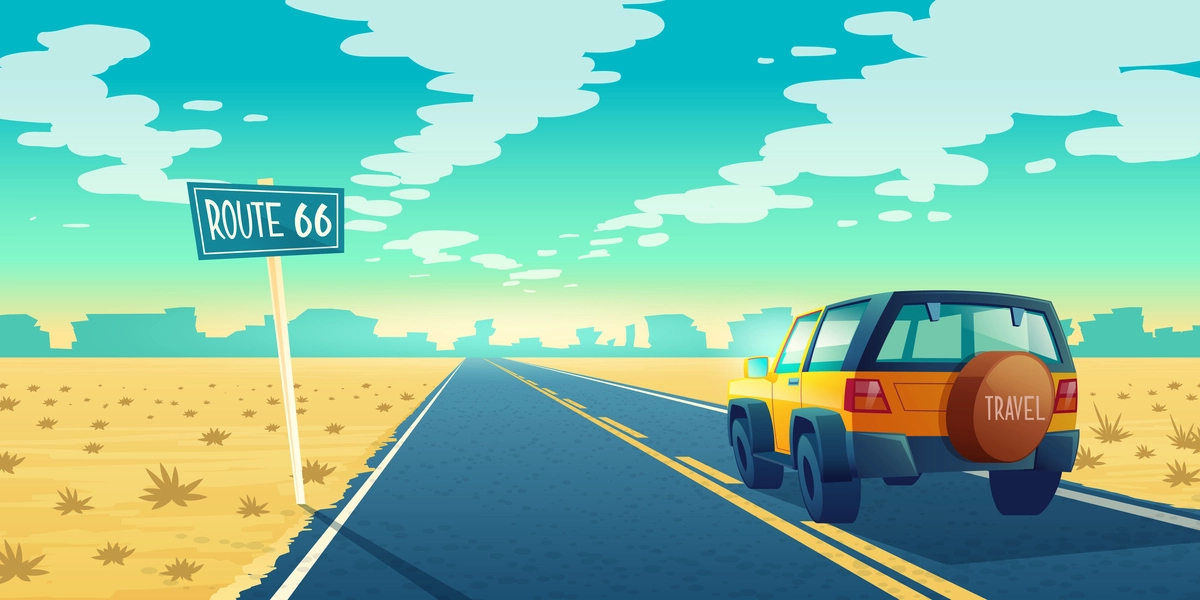
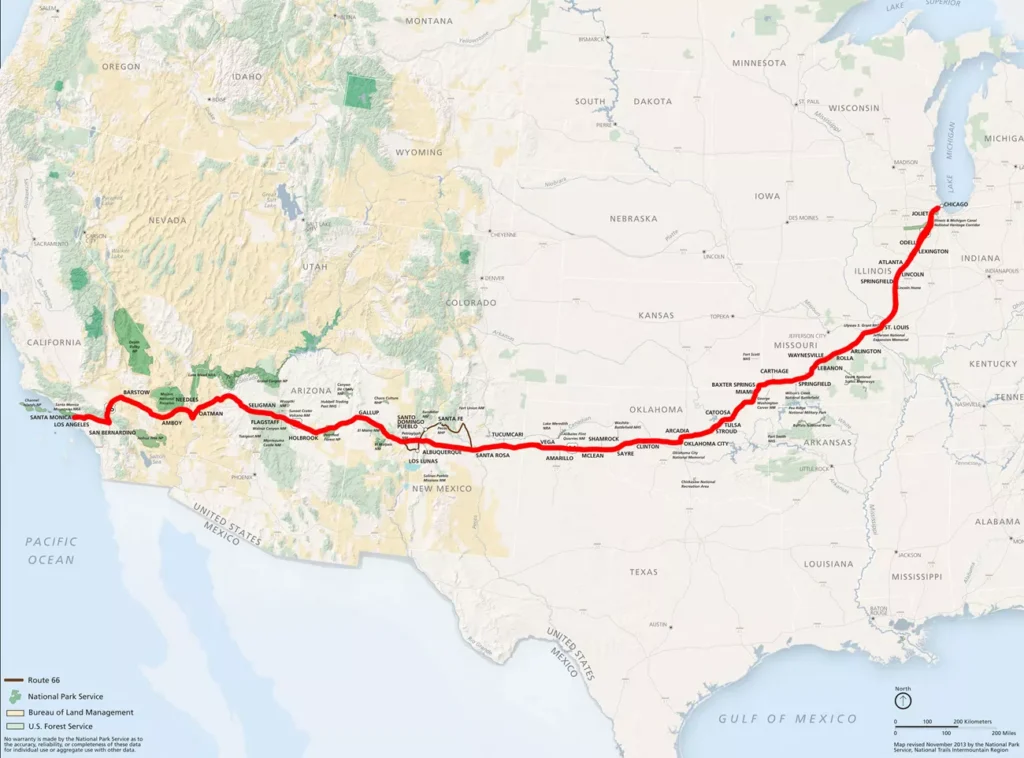
Route 66 is a United States federal highway officially designated as U.S. Route 66, connecting Chicago, Illinois, with Santa Monica, California.
Opened in 1926 and in full operation until it was officially removed from the U.S. highway system in 1985, Route 66 stretches a total length of approximately 3,940 kilometers (2,448 miles).
Route and Geography
Route 66 passes through eight states, each with its own unique character and scenery:
- Illinois — beginning in the heart of Chicago, passing through the vast Midwest cornfields
- Missouri — through St. Louis, home to the iconic Gateway Arch
- Kansas — just 21 kilometers, but passing through the historic town of Galena
- Oklahoma — covering more miles of Route 66 than any other state
- Texas — crossing the Texas Panhandle with its wide-open landscapes and endless skies
- New Mexico — cutting through the desert with stunning red rock formations
- Arizona — passing through the Grand Canyon State with its iconic desert scenery
- California — ending at Santa Monica Pier on the edge of the Pacific Ocean
A full end-to-end journey takes about two to three weeks if you truly want to savor every stop, small town, classic diner, and spectacular view along the way.
Read more: Top 10 National Parks in America
Route 66’s Nicknames and Characteristics
Throughout its history, Route 66 has been known by various nicknames that reflect its cultural significance:
- “The Mother Road” was popularized by author John Steinbeck in his novel The Grapes of Wrath, describing how the road became a lifeline for thousands of families migrating during the Great Depression.
- “The Main Street of America” — because it passes through the heart of so many small towns.
- “The Will Rogers Highway” — in honor of the famous comedian Will Rogers.
- “The Glory Road” — reflecting the highway’s golden era in the mid-20th century.
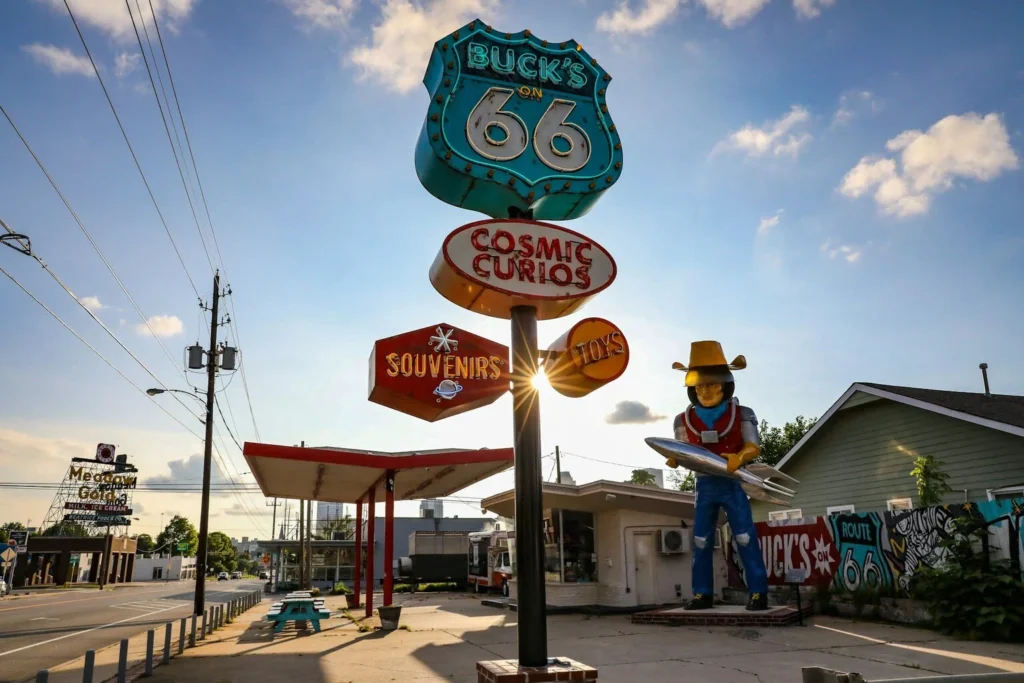
Along Route 66, travelers will encounter retro diners with jukeboxes and classic milkshakes, vintage motels with neon signs, antique gas stations now turned museums, souvenir shops stocked with Route 66 memorabilia, and unique landmarks such as giant statues and novelty architecture. Together, these elements create an authentically nostalgic experience from America’s golden age in the mid-20th century.
Read more: 6 Must-Visit Tourist Destinations in the U.S.
The History of Route 66
The Birth of Route 66
Before 1926, roads across America were largely unpaved dirt tracks that were difficult to travel. The Good Roads Movement pushed for infrastructure improvements as the automobile industry grew.
In 1926, Route 66 was officially established to connect Chicago and Los Angeles, pioneered by Cyrus Avery. The road merged existing local routes, which were then widened and paved, with the project completed in 1938. The number “66” was chosen simply because it was easy to remember.
The Migration Era (1930s)
When the Great Depression and the Dust Bowl disaster struck, Route 66 became the primary migration route to California. Thousands of families traveled it in search of a new life. John Steinbeck called it the “Mother Road” in his novel The Grapes of Wrath. Small towns along the route flourished with motels, restaurants, and gas stations becoming the backbone of new local economies.
The Decline (1960s–1980s)
The development of the Interstate Highway System from 1956 onward rendered Route 66 obsolete, as it was no longer considered efficient. New expressways bypassed small towns, causing local businesses to lose foot traffic. Many towns became ghost towns. On June 27, 1985, Route 66 was officially decommissioned from the federal highway system.
Revival and Cultural Legacy (1990s–Present)
A preservation movement emerged to save Route 66 as a piece of historical heritage. Governments and local communities began restoring landmarks and promoting it as Historic Route 66. Today, Route 66 has been reborn as a heritage tourism destination, drawing visitors from around the world who come to experience America’s nostalgia and history firsthand.
Why Is It Called a Legendary Road?
A question that often comes up: why did Route 66 become so legendary? After all, there are thousands of other highways across America. What makes Route 66 so special?
A Symbol of the American Dream
Route 66 is a manifestation of the American Dream — the idea that through hard work and courage, anyone can build a better life.
Route 66 carries a meaning far deeper than simply connecting point A to point B — “it’s not the destination, it’s the journey.” This resonates deeply with American values of individualism, adventure, and the frontier spirit.
A Driver of Popular Culture
Route 66 has been immortalized in so many works of popular culture that it has transcended its status as infrastructure to become a cultural icon:
| Music | Route 66, written by Bobby Troup in 1946 and popularized by Nat King Cole, became a jazz standard covered by dozens of artists, including Chuck Berry, The Rolling Stones, and Depeche Mode. Its catchy lyric — “Get your kicks on Route 66” — became the road’s timeless slogan. |
| Film | The Grapes of Wrath (1940) Easy Rider (1969) Pixar’s Cars (2006) |
| Literature | Beyond Steinbeck, many writers have used Route 66 as a metaphor or setting, including works from the Beat Generation. |
Unique Architecture and Americana
Route 66 is often described as an open-air museum of 20th-century American vernacular architecture. Along its stretch, visitors can discover all manner of unique roadside architecture — restaurants shaped like giant hot dogs, souvenir shops built in the form of wigwams (Native American tipis), and restored Art Deco gas stations.
This visual richness is amplified by a collection of vintage neon signs — from flickering motel boards to colorful restaurant marquees — that create a distinctly mid-century American atmosphere after dark.
What’s more, many motels, diners, and local businesses from the 1940s to 1960s still preserve their Mid-Century Modern designs, complete with red vinyl seats, formica tables, checkered floors, and jukeboxes that deliver an authentic taste of Route 66’s heyday.
Read more: Recommendations of Popular Cafes in America
Nostalgia and American Identity
Route 66 offers a deeply personal experience through family-owned restaurants that have survived for generations, motels where owners greet guests personally, and small volunteer-run museums brimming with passion for preserving local history.
In an era of globalization, Route 66 has become a symbol of nostalgia. For Americans, it is part of a collective identity and a symbol of what it means to be American. For international visitors, the route offers a chance to experience the “real America” by immersing themselves in small-town life that represents the heart and soul of the country.
Conclusion
More than just a road, Route 66 is the story of a nation, a symbol of human aspiration, and a reminder that the journey is often more meaningful than the destination. From its birth in 1926 to its revival as a heritage tourism destination, America’s Route 66 has become a mirror of America’s own evolution.
Route 66 is a living history lesson, an open-air museum of popular culture, and an invitation to adventure. It teaches us about resilience — how communities can survive and adapt through change. It reminds us of the importance of preserving the past while embracing the future. And above all, it celebrates the human spirit that never stops seeking, exploring, and dreaming.
Get to Know More About America
Interested in exploring American culture, history, and innovation more deeply? Why not become part of @america?
At @america, you don’t just learn about America — you become part of a passionate and open community of learners. Meet people who share your interests, practice your English in a supportive environment, and expand your network.
We regularly host exciting and enriching events that you can join. Check out the @america event schedule here, or follow @america on Instagram for the latest updates!